
Organisations and entities
Vitesse uses organisations and entities to represent how your business operates on the platform.
This structure provides the foundation for organising users, accounts, and access.
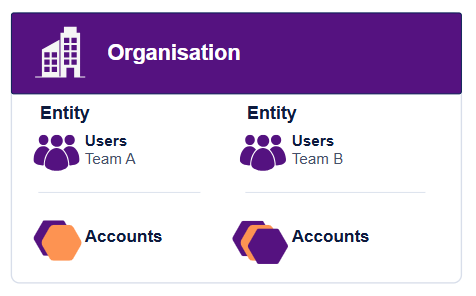
The following sections explain organisations and entities in more detail.
Organisation
An organisation is the top-level workspace in Vitesse.
It represents your business on the platform and contains its entities. Together, these entities organise your users, accounts, and access.
An organisation can represent:
- A single company
- Multiple related companies operating together
Entity
An entity is an operational unit within an organisation that separates different parts of a business. For example it can represent:
- A business unit or division
- A regional operation
- A line of business
- A trading name
An entity does not need to match a legal entity. It represents how you assign responsibility in practice.
Entities define who manages accounts, users, and activity within that part of the business. Each account and user is assigned to one entity. User roles and account access then determine what each user can view and do.
Administrators can grant users access to selected accounts across the organisation, regardless of which entity they belong to.
Administrators can also share selected accounts with partner organisation entities through service relationships, which allow partners to access and manage shared accounts. For more information, see Account access.
When to use an entity
Consider using a separate entity when:
- A specific team manages a set of accounts
- You want to separate access between groups
- You want to track activity independently
Updated 3 months ago