
Field mappings
How batch fields are mapped to transaction fields
This page relates to bank transfer payment batches. For cheques, refer to Cheques.
As mentioned in the overview on batches, the fields within the batch file are mapped to properties of a transaction request as follows.
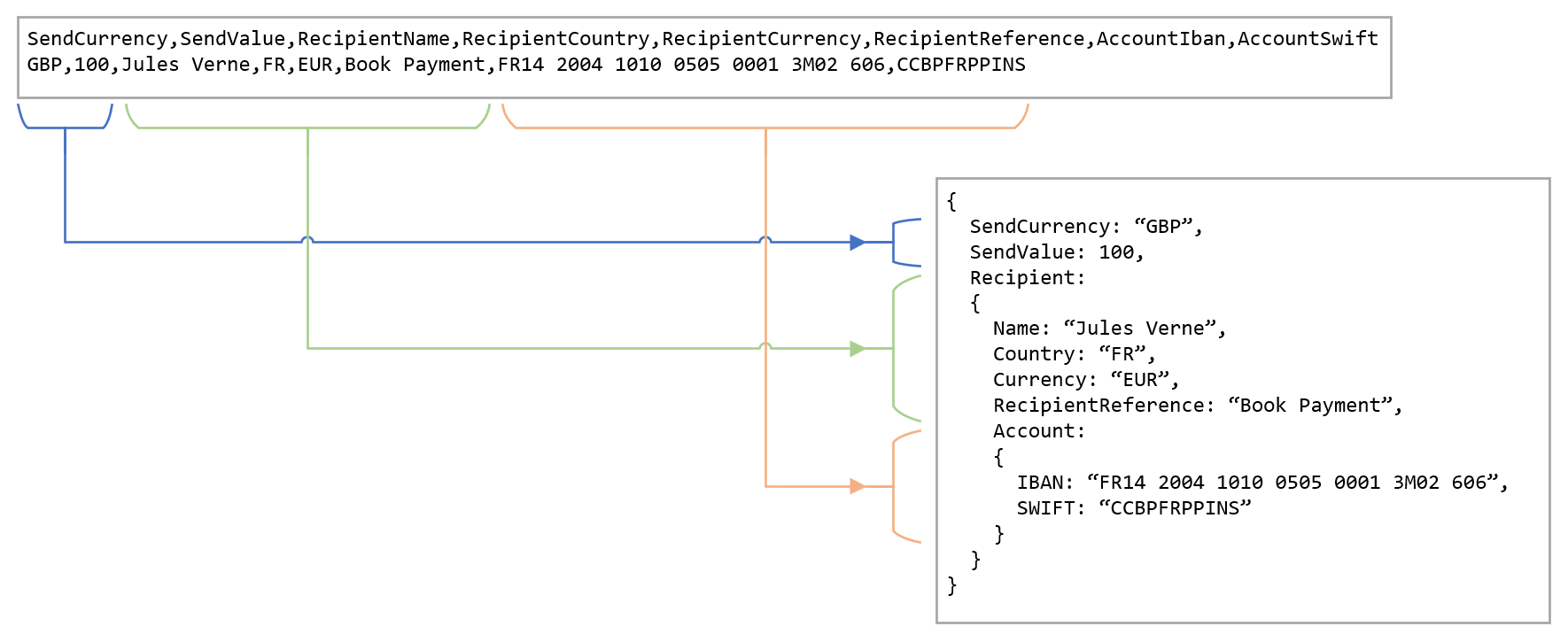
There are four distinct sections that make up a transaction request, and for simplicity we've tried to ensure that an appropriate naming convention is used so you can determine where a given field will be mapped based solely on its name. These sections, and the fields that make up these sections are discussed below.
Transaction Fields
These fields are associated with the transaction itself, and do not have a prefix. The transaction is considered to the the "container" for recipient data, as the recipient is in effect a sub-object of the transaction.
Parameters with an * (asterisk) are mandatory. Bracketed asterisks (*) are for mandatory parameters with exceptions.
| Name | Datatype | Comments |
|---|---|---|
| CorrelationId | String (64) | This could be the unique ID in your system, or a unique request ID. We only store this value, nothing is done with it. |
| DateSearchMode | String: 'Forward' or 'Backward' (default) | Used for queued transactions to determine which direction to search for a value date. See Queued Transaction Overview for details. |
| ExternalReference1 | String (128) | Optional data provided by your system. Typically used to store the primary key of a transaction in your system. |
| ExternalReference2 | String (128) | Optional data provided by your system. |
| ExternalReference3 | String (128) | Optional data provided by your sysem. |
| Extra | String (4000) | An optional string that your system can send to ours which allows you to store additional data alongside the transaction. This is typically used to store structred data as JSON. |
| FundingType | String: 'Immediate' (default), 'Deferred' or 'FundingMerchantLookup' | This defines the funding model for the transaction. For details of what this field is used for, please see Funding Type |
| LatePaymentMode | String: 'Cancel' (default) or 'Continue' | Defines what happens with a queued deferred transaction if your payment doesn't show up in time. See Queued Deferred Transaction Overview for details. |
| RateGroupDurationInDays | Integer | Specifies the number of days to use when creating a rate group (for deferred transactions). Either RateGroupDurationInDays or RateGroupId needs to be specified for deferred TX. See here for further details. |
| RateGroupId | Integer | If used, defines the rate group used when creating deferred transactions. Either RateGroupDurationInDays or RateGroupId needs to be specified for deferred TX. See here for further details. |
| ReceiveValue(*) | Decimal | The amount you wish the recipient to receive. See the notes below. |
| RequestedValueDate | Date | For queued or queued deferred transactions, this is the date you would like the recipient to receive their funds. Note - this is not the Value Date - we compute that in our system and return it to you. See Queued Transaction Overview for more details. |
| RouteType | String. If omitted, 'BankAccount' is the default. | See the documenttation on Rules for further details here. |
| SendAccountId | Integer | You may have linked accounts setup, in which case this allows you to select which available account to debit funds from. |
| SendCurrency* | ISO 4217 currency code such as 'GBP', 'EUR' and 'USD'. | |
| SendValue(*) | Decimal | The amount you wish to send to the recipient, in the SendCurrency. See notes below. |
| Source | String (64) | Another optional field, you may wish to use this to define which of your systems the transaction came from. Typically unused. |
(*) When posting a transaction, you need to either specify how much you want to send, with a value in the SendValue column, or how much you want the recipient to receive, in which case you use the ReceiveValue field. Use one or the other of these values, but not both.
Recipients (both types)
There are two types of recipient in our system - regular recipients (i.e. recipients you are only likely to pay once), and stored recipients, which you may wish to pay multiple times.
Recipient Fields
The following are the fields to specify for a recipient.
Parameters with an * (asterisk) are mandatory.
| Name | Datatype | Comments |
|---|---|---|
| RecipientAddress | String (256) | For unstructured addresses, and will be overwritten by the structured address if both are supplied. |
| RecipientAddressStreetName | String (128) | For structured addresses |
| RecipientAddressBuildingNumber | String (16) | For structured addresses |
| RecipientAddressLine1 | String (128) | For structured addresses |
| RecipientAddressLine2 | String (128) | For structured addresses |
| RecipientAddressTownName | String (128) | For structured addresses: City |
| RecipientAddressPostCode | String (128) | For structured addresses: Zip Code |
| RecipientAddressCountrySubDivision | String (128) | For structured addresses: e.g. US States |
| RecipientAddressCountry | String (2) | For structured addresses: Country Code |
| RecipientBirthdate | Date | |
| RecipientCountry* | String (2) - ISO 3166 Alpha 2 such as GB, DE and FR | |
| RecipientCurrency* | String (3) - ISO 4217 such as GBP, USD or AUD | |
| RecipientEmail | String (128) | |
| RecipientName* | String (256) | |
| RecipientNationality | String (2) - ISO 3166 Alpha 2 such as GB, DE and FR | |
| RecipientPhoneNumber | String (32) | |
| RecipientReference* | String (128)* | This is the reference that typically shows on the recipients bank statement |
| RecipientType | Person (the default if not supplied) or Business | Defines the type of recipient. This is typically an individual but may be a business entity. |
The RecipientReference field supports a maximum of 128 characters, however, depending on the route this value may be significantly shorter. See the documentation on Rules for further information as to how to determine the fields that are mandatory for a given route. The field validations are route dependent.
Deprecated legacy address fields
Do not use the following legacy fields in your batches:
| Legacy field | Use instead |
|---|---|
RecipientAddressCompanyName | PostalRecipientAddressCompanyName |
RecipientAddressForAttentionOf | PostalRecipientAddressName |
RecipientAddressLine3 | An appropriate ISO 20022 structured address field |
We continue to support these legacy fields for backward compatibility, but we may remove them in a future release.
Stored Recipient Fields
The following fields are those that are used when selecting an existing recipient.
Parameters with an * (asterisk) are mandatory.
| Name | Datatype | Comments |
|---|---|---|
| RecipientEmail | String (128) | |
| RecipientReference* | String (128)* | This is the reference that typically shows on the recipients bank statement |
| StoredRecipientId* | String (64) | This defines the unique ID of the stored recipient, and is typically the primary key in your system for the stored recipient. When you create stored recipients in our system, you can supply this value at that point. For more information please see the documentation on Recipients. This value is the ExternalStoredRecipientId from the stored recipient API. |
As for regular recipients, the length of the RecipientReference field is dependant on the destination country.
Account Fields
There are a large number of fields associated with an account, and these are all dependant on the destinarion country and currency. You can omit any of these fields you're not using - so if for example your batch file contains only payments to Europe, you can just specify the IBAN and SWIFT codes and omuit all other columns entirely. You only need column headers in the file for the columns you're using.
| Property | Type | Description |
|---|---|---|
| AccountAbaCode | String | ABA code |
| AccountNumber | String | Account number |
| AccountBankAccountType | String | Bank account type. Values will vary by country. For US/USD, you can use "Checking" or "Savings", if omitted then the deafult is "Checking". |
| AccountBankAddress | String | Bank address |
| AccountBankCity | String | Bank city |
| AccountBankMfo | String | Payee's bank MFO |
| AccountBankName | String | Bank name |
| AccountBban | String | BBAN |
| AccountBIK | String | BIK Code |
| AccountBinOrIin | String | BIN or IIN |
| AccountBranchAgencyCode | String | Branch agency code |
| AccountBranchCode | String | Branch code |
| AccountBranchName | String | Branch name |
| AccountBsbCode | String | Bank State Branch code |
| AccountChineseId | String | Chinese Id |
| AccountClabe | String | CLABE |
| AccountIban | String | IBAN |
| AccountIdCardOrPassportNumber | String | ID card or passport number |
| AccountIfscCode | String | IFSC code |
| AccountKnpOrUpdc | String | KNP or UPDC |
| AccountKonstant Symbol | String | Konstant symbol |
| AccountNibCode | String | NIB code |
| AccountNuban | String | NUBAN |
| AccountPaymentCode | String | Payment code |
| AccountPaymentPurpose | String | Purpose of payment |
| AccountProvince | String | Province |
| AccountRegistrationNumber | String | Registration number |
| AccountRoutingNumber | String | Routing number |
| AccountSortCode | String | Sort code |
| AccountSpecificSymbol | String | Specific symbol |
| AccountSwift | String | Swift code |
| AccountTaxId | String | Tax Id |
| AccountVariableSymbol | String | Variable symbol |
| AccountVoCode | String | VO code |
| AccountBankGiro | String | Swedish BankGiro Number |
| AccountPlusGiro | String | Swedish PlusGiro Number |
| AccountOcrReferenceNumber | String | OCR Reference Number |
| AccountBankCode | String | Bank Code |
| AccountKidReferenceNumber | String | Swedish KID Reference Number |
All of the account fields have validation associated with them based on rules. Please see the Rules section for details, and login to the Merchant Administration System for the details of specific country/currency combinations.
Originator Fields (optional)
Some of our merchants send in tranasctions for which they are not the originator - this might be the case if you are an aggregator and receive transactions from your customers which are passed on to us.
In this case we'll have set you up as requiring to send originator details to us. These fields identify the originator of the funds. The fields are as follows and are all mandatory, should you wish to add originator data to the batch line.
| Name | Datatype | Comments |
|---|---|---|
| OriginatorAddress | String (256) | |
| OriginatorIdentifier | String (256) | Commonly the primary key in your system for the originator, but could also be details such as a National Insurance number in the UK, or a Social Security number in the US. |
| OriginatorName | String (256) |
Updated 3 months ago