
Payment lifecycle
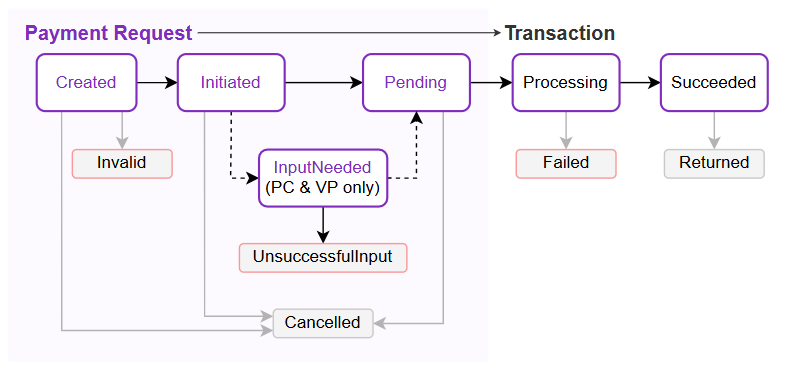
A payment has two distinct phases:
- Payment request – represents the intent to make a payment, where required input is captured, validated, and pre-processed
- Transaction – represents the execution phase, where risk screening and routing occur, a payment system or bank is engaged, and funds are transferred
As the payment progresses through these phases, its status updates until it reaches a terminal state.
Checking the current payment status using the API
Send:GET /payment-request/{id}
You can also receive status updates through Webhooks.
Use the tables below to understand the payment lifecycle statuses.
Payment request statuses
| Status | Description |
|---|---|
Created | The payment request is recorded but not yet submitted for validation. |
Invalid | A terminal state. The request contains errors or is missing required data and cannot proceed. |
Initiated | The payment request passed validation (where checks are made for errors or missing data) and was accepted. |
InputNeeded | For Payee Choice and Vendor Pay payments only. Waiting for required additional information from the recipient. |
UnsuccessfulInput | A terminal state for Payee Choice and Vendor Pay payments only. The recipient did not provide required information. |
Pending | The request is valid but queued for processing. |
Cancelled | A terminal state. The payment request was cancelled before the transaction was processed. For more information, see Payment request cancellation reasons. |
Transaction statuses
| Status | Description |
|---|---|
Processing | The transaction is currently being executed. |
Succeeded | The transaction completed successfully. For most payment types, funds were paid out. For postal cheques, the cheque is dispatched. For eChecks, the email containing a link to the payment was sent. |
Failed | A terminal state. An error occurred during processing, and the payment was not completed. |
Returned | A terminal state. The transaction succeeded but was later reversed or rejected by the payment system or bank. |
For more details on status transitions, delays and recovery, see:
Updated 4 months ago